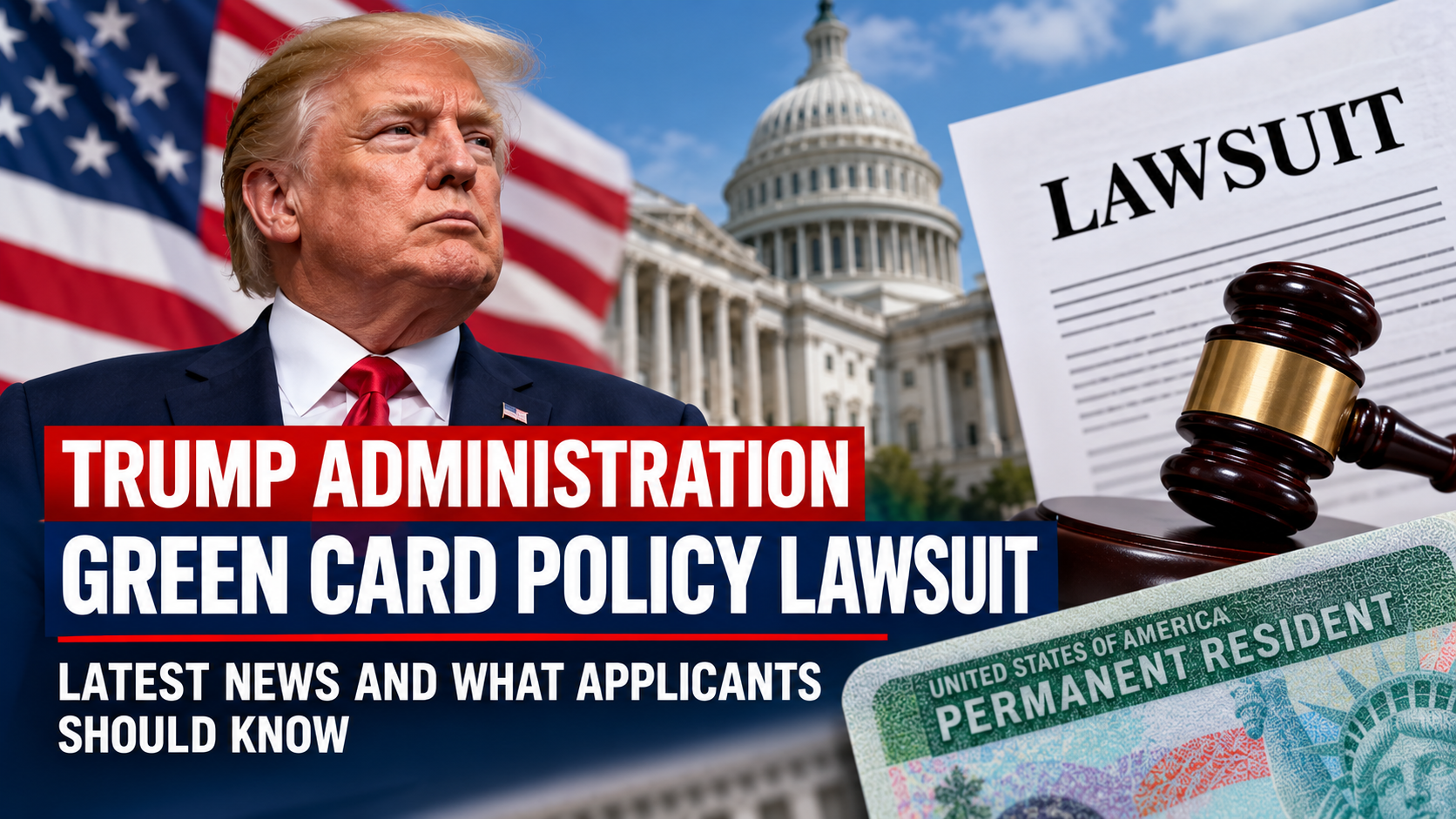
The Trump administration is facing a federal lawsuit over new green card policies that could make it more difficult for certain immigrants already living in the United States to obtain lawful permanent residence without leaving the country. Filed on October 5, 2026, the lawsuit challenges two policy changes introduced by U.S. Citizenship and Immigration Services (USCIS), the federal agency responsible for administering many U.S. immigration benefits.
The case focuses on the adjustment of status process, which allows eligible immigrants to apply for a green card from within the United States rather than pursue an immigrant visa through a U.S. embassy or consulate abroad. The plaintiffs argue that the administration’s new policies create additional barriers for eligible applicants and could disrupt families, employment, education, and other aspects of their lives.
According to immigration law firm Fragomen, both challenged policies remained in effect when the lawsuit was reported on October 5, 2026. The plaintiffs are seeking court intervention to block the policies while the case proceeds.
For immigrants with pending green card applications, the case raises important questions about application review procedures, documentation requirements, and the options available if USCIS denies an application.
Important: Filing a lawsuit does not automatically suspend an immigration policy. Applicants should verify the latest court developments and consult a qualified immigration attorney before making decisions about travel, employment, or immigration status.
What Is the Latest News About the Trump Administration Green Card Policy Lawsuit?
On October 5, 2026, immigrant rights organizations, labor unions, university faculty groups, and individual applicants filed a lawsuit in the U.S. District Court for the District of Massachusetts challenging two USCIS policy changes affecting adjustment of status.
The lawsuit, titled Lawsuit Challenges USCIS Policies Restricting Adjustment of Status for Lawful Permanent Residence, questions the legality of policies introduced in May and August 2026.
The plaintiffs contend that the changes depart from longstanding adjustment of status practices and could make it harder for eligible immigrants to obtain permanent residency while remaining in the country.
The case is pending, and the plaintiffs are asking the court to block the challenged policies and ultimately set them aside.
Sources:
- American Immigration Council: Lawsuit Challenges USCIS Policies Restricting Adjustment of Status
- Fragomen: Lawsuit Seeks to Enjoin Recent USCIS Policies
- American Immigration Lawyers Association: New Lawsuit Challenges Administration Policies
What Are the Two USCIS Green Card Policies Being Challenged?
The lawsuit concerns two separate policy changes that affect how immigration officers review applications for lawful permanent residence.
1. May 2026 Policy on Adjustment of Status
On May 22, 2026, USCIS announced a policy memorandum emphasizing that adjustment of status is a discretionary immigration benefit and directing officers to consider relevant circumstances when deciding whether to approve an application.
The agency’s announcement characterized adjustment of status as an exceptional alternative to the ordinary consular immigrant visa process. Under the announced approach, officers are directed to consider whether an applicant’s circumstances justify granting permanent residence from within the United States.
The plaintiffs challenge the policy’s treatment of choosing adjustment of status instead of consular processing as a negative discretionary factor. They argue that this approach imposes additional obstacles on otherwise eligible applicants.
The distinction matters because adjustment of status is established under Section 245 of the Immigration and Nationality Act, although eligibility depends on the applicable statutory requirements and immigration category.
Official and legal resources:
2. August 2026 Policy on Requests for Evidence and Denials
The second challenged policy concerns how USCIS handles applications with missing or insufficient evidence.
USCIS announced updated guidance on August 5, 2026, concerning Requests for Evidence (RFEs) and Notices of Intent to Deny (NOIDs). Under the revised guidance, officers have greater discretion to deny certain applications when required initial evidence is missing or the submitted material does not establish eligibility, without first requesting additional documentation.
The plaintiffs argue that this change increases the risk of denials for applicants who might otherwise have been able to address deficiencies in their submissions.
For applicants, the practical lesson is straightforward: immigration forms should be completed carefully, required initial evidence should be included, and filing instructions should be reviewed before submission.
An RFE or NOID is not guaranteed in every case, so applicants should not assume that USCIS will always provide another opportunity to correct missing or insufficient documentation.
Sources:
- USCIS Policy Memoranda
- American Immigration Lawyers Association: USCIS Policy Alert on Evidence, RFEs, and NOIDs
What Is Adjustment of Status, and Why Does It Matter?
Adjustment of status is a legal process that allows certain eligible noncitizens physically present in the United States to become lawful permanent residents without completing the ordinary immigrant visa process abroad.
Applicants generally submit Form I-485, Application to Register Permanent Residence or Adjust Status, to USCIS. Eligibility depends on the immigration category, visa availability where applicable, admissibility requirements, and other legal conditions.
Adjustment of status may be available to qualifying individuals through several pathways, including:
- Eligible immediate relatives of U.S. citizens.
- Certain other family-sponsored immigrants.
- Eligible employment-based immigrants.
- Certain special immigrant categories and other statutory pathways.
Not every visa holder or immigrant living in the United States qualifies to adjust status. Some applicants are subject to restrictions or additional requirements, and individual eligibility must be assessed under the applicable law.
The adjustment of status process is important because it can allow eligible applicants to pursue permanent residence without traveling abroad for consular processing. The new policies and the resulting lawsuit have therefore attracted attention from immigrant families, workers, educational institutions, and employers.
For official eligibility information, consult the USCIS Policy Manual and the Form I-485 page.
Who Could Be Affected by the Green Card Policy Lawsuit?
The potential impact depends on the applicant’s immigration category, current status, application history, and the final outcome of the case.
Family-Based Green Card Applicants
Some immigrants seek permanent residence through qualifying family relationships. For these applicants, changes to adjustment of status procedures could create uncertainty about how their applications will be reviewed.
If an applicant must pursue consular processing abroad, the process may involve additional travel arrangements, appointment scheduling, and questions about maintaining family unity.
However, the lawsuit does not mean that all family-based applications will be denied or that every applicant must leave the United States. Eligibility and available procedures depend on the individual’s circumstances.
Employment-Based Green Card Applicants
Workers pursuing employment-based permanent residency may also be affected if their applications fall within the scope of the challenged policies.
Potential concerns include the timing of an application, continued eligibility, work authorization, and the consequences of a denial. Employment authorization and permanent residence are separate legal matters, so applicants should verify their current documents and any relevant deadlines.
Employers and employees should avoid assuming that a pending green card application automatically guarantees continued work authorization or protects an individual from every immigration consequence.
International Students and Researchers
Some international students and researchers may eventually pursue permanent residency through employment or other qualifying immigration categories.
The lawsuit has drawn attention from university faculty groups and other organizations concerned about the potential effects of the policies on education, research, and employment.
The actual impact will depend on the individual’s immigration status and whether they qualify for adjustment of status under the applicable rules.
Applicants With Pending Form I-485 Applications
People whose Form I-485 applications were filed before the policy changes may be particularly concerned about how USCIS will review their cases.
The lawsuit raises questions about the application of the new guidance to pending cases. However, applicants should not assume that every previously filed application is exempt from the revised policies or that every pending application will be denied.
Applicants should continue monitoring their USCIS case status, retain copies of their filing records, and seek legal advice if they receive a request for evidence, a notice of intent to deny, or a denial.
Does the Lawsuit Mean Green Card Applicants Must Leave the United States?
No. The lawsuit itself does not establish a universal requirement for all green card applicants to leave the country.
The challenged policies concern the circumstances in which USCIS may exercise discretion over adjustment of status applications. Immigration law contains different pathways and eligibility rules, and some individuals may qualify to adjust status while others may need to pursue consular processing.
Whether an individual can remain in the United States, travel abroad, or apply through a different process depends on their immigration history, status, category, and applicable legal restrictions.
Leaving the United States without understanding the consequences can create serious immigration complications in some circumstances. Anyone considering international travel while an application is pending should obtain case-specific legal advice before departing.
Applicants can review the USCIS Policy Manual for official information about adjustment of status.
What Is the Difference Between This Lawsuit and the Public Charge Policy Changes?
The adjustment of status lawsuit should not be confused with separate legal challenges involving the public charge rules.
Adjustment of status policies concern the process and circumstances under which eligible immigrants may apply for permanent residence from within the United States.
Public charge rules concern whether certain immigrants may be found inadmissible because they are considered likely to become primarily dependent on government support under the applicable legal standard.
USCIS announced updated public charge guidance in August 2026 following a separate federal rulemaking process. That issue involves different legal questions from the May and August adjustment of status policies challenged in the October lawsuit.
The two subjects may overlap for some green card applicants, but they are not the same legal issue.
Applicants who have questions about public benefits and immigration eligibility should consult the relevant official guidance and obtain advice tailored to their circumstances.
Official source: USCIS Policy Memoranda and Immigration Guidance.
What Should Green Card Applicants Do While the Lawsuit Is Pending?
While the case proceeds, applicants can take practical steps to protect their records and reduce avoidable application errors.
1. Review Your Eligibility
Confirm which immigration category applies to your case and review the relevant eligibility requirements. A family-based application, an employment-based application, and other adjustment categories may involve different rules.
2. Submit Complete and Accurate Documentation
Carefully review Form I-485 instructions and the evidence required for your particular category. Missing documents, inconsistent information, or incomplete forms may create problems during adjudication.
Use the official USCIS Form I-485 page to access the latest form and instructions.
3. Monitor Your Application
Check your case status and keep copies of notices received from USCIS. If the agency requests information or issues a notice, review the stated deadline and follow the instructions carefully.
Use the official USCIS Case Status Online tool to check your application status.
4. Do Not Make Travel Decisions Based on Headlines
The lawsuit does not provide an automatic travel authorization or establish that every applicant must pursue consular processing. Travel can have different consequences depending on the person’s immigration status and pending applications.
Obtain qualified legal advice before leaving the United States if you have a pending application or questions about maintaining your status.
5. Consult a Qualified Immigration Attorney
An immigration attorney can assess your eligibility, explain how the current policy may apply, and discuss available options if your application is delayed or denied.
Applicants should be cautious about relying on generalized online claims, especially when a legal case is still pending.
What Happens Next in the Trump Administration Green Card Lawsuit?
The court will consider the legal arguments raised by the plaintiffs and the administration’s response.
The plaintiffs are seeking court orders that would block the challenged policies while litigation continues and ultimately set them aside. The court may consider requests for temporary relief before reaching a final decision on the merits.
Several outcomes are possible. The court could grant some or all of the requested relief, deny the request, or issue an order that addresses only particular aspects of the dispute. Any ruling would need to be reviewed to understand which applicants and policies it covers.
As of October 9, 2026, the legal sources cited in this article report the case as pending and the challenged policies as remaining in effect. Readers should check for subsequent court orders before relying on that status.
For updates, monitor the American Immigration Council’s case page, official USCIS policy information, and reliable legal reporting.
Frequently Asked Questions
Has the Trump administration green card policy lawsuit been decided?
The case was reported as pending in the available legal updates as of October 9, 2026. The plaintiffs are seeking to block and invalidate two USCIS policies affecting adjustment of status. Check current court records and reliable legal updates for subsequent developments.
Can I still apply for a green card from inside the United States?
Some eligible immigrants can still apply for adjustment of status under applicable immigration law. Eligibility depends on the relevant category and individual circumstances. The lawsuit challenges the administration’s policies governing the process; it does not itself abolish adjustment of status.
Will USCIS deny all pending green card applications?
No. The existence of the lawsuit does not automatically mean that all pending applications will be denied. Each application must be evaluated under the applicable rules and the applicant’s circumstances.
Can an H-1B visa holder be affected by the lawsuit?
An H-1B visa holder pursuing employment-based permanent residence could be affected if their adjustment of status application falls within the scope of the challenged policies. The specific consequences depend on eligibility, immigration history, and the current legal framework.
Does the lawsuit automatically protect applicants from deportation?
No. Filing or being affected by a lawsuit does not automatically grant lawful status, prevent removal, or authorize someone to remain in the United States. Anyone concerned about removal proceedings or immigration status should obtain individualized legal advice.
Where can I find official green card policy updates?
Applicants can consult the USCIS website, the USCIS Policy Manual, and the official Form I-485 page. For information about a pending lawsuit, reliable legal organizations and court records can provide additional context.
Conclusion
The Trump administration green card policy lawsuit filed on October 5, 2026, challenges two USCIS policy changes that affect adjustment of status applications. The dispute concerns the treatment of applying for permanent residence from within the United States and the circumstances in which immigration officers may deny applications without first requesting additional evidence.
The plaintiffs argue that these policies create new obstacles for eligible immigrants and may disrupt families, employment, and education. The administration has defended its approach to immigration enforcement, and the court will determine the legal questions raised in the case.
For green card applicants, the key takeaway is that the lawsuit does not automatically suspend the challenged policies or guarantee a particular outcome. Applicants should continue following applicable filing requirements, keep their records organized, monitor official announcements, and seek qualified legal advice before making important immigration decisions.
Editorial disclaimer: This article is for general informational purposes and does not constitute legal advice. Immigration policies and court orders may change. The case status described above reflects information available as of October 9, 2026, and should be verified before publication or when making immigration decisions.
Sources and Official Resources
- American Immigration Council — Lawsuit Challenging USCIS Adjustment of Status Policies
- Fragomen — Legal Analysis of the USCIS Lawsuit
- American Immigration Lawyers Association — Lawsuit Announcement
- USCIS — Official Immigration Policy Memoranda
- USCIS — Policy Manual
- USCIS — Form I-485
- USCIS — Case Status Online
Suggested meta title:
Suggested meta description:
Suggested URL slug:
Recommended internal links: Add contextual links to existing pages on family-based green cards, employment-based immigration, adjustment of status, USCIS requests for evidence, and immigration legal services, where relevant.
Recommended update practice: Review the article whenever the court issues a material order or USCIS announces a relevant policy change. Update the displayed date only when the content has actually been reviewed and substantively revised.